
14.1 Continuous Rules
Before reading these, you should consult the General Rules of Pocket Billiards. Except when clearly contradicted by these additional rules, the General Rules of Pocket Billiards apply when playing 14.1 Continuous.
14.1 Continuous Rules
This page contains references to some material that is copyrighted by the Billiard Congress of America. Any modification or sale of such information herein is strictly prohibited by the laws governing that copyright. Please direct questions regarding interpretation of the following, or information on how to receive the current BCA "Billiards - The Official Rules and Records book" to the Billiard Congress of America.
If there are any terms throughout the 14.1 Continuous Rules that you do not understand, you can search our billiard terms glossary in the search box near the top left of the page, or search the billiard terms glossary directly. I have also included the Billiard Congress of America's reference numbers, so that readers can reference each rule back to the specific rule text on the Billiard Congress of America website.
Object of 14.1 continuous (Regulation 6.1)
14.1 is a nomination game, in that the player must nominate an object ball and a pocket. The player is given one point for every correctly nominated and pocketed ball on a legal stroke, and is allowed to continue a turn until failure to pocket a nominated ball or commits a foul. The player can pocket the first 14 balls, but before continuing a turn by shooting at the 15th, being the last remaining ball on the table, the 14 pocketed balls are racked as before, except with the apex space vacant. The player then attempts to pocket the 15th ball in a manner so that the racked balls are disturbed and he can continue the run. The player who scores the predetermined point total for a game, prior to the opponent, wins the game. The predetermined point total is usually 150 in major tournament play, or any agreed upon total in casual play.
Players (Regulation 6.2)
14.1 Continuous is played either with two players, or in teams of two.
Balls Used (Regulation 6.3)
A standard set of object balls, numbered 1 through 15, plus the cue ball comprises the set of balls used in 14.1 Continuous.
The Rack (Regulation 6.4)
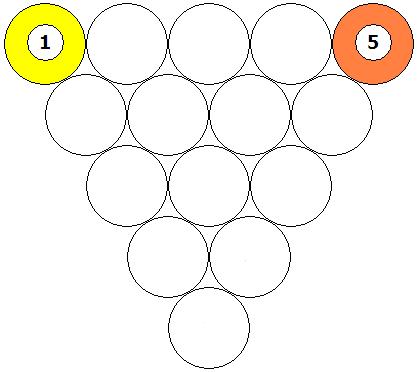
14.1 Continuous uses a standard triangle rack with the apex ball on the foot spot, the 1-ball on the racker's right corner, and the 5-ball on left corner. Other balls are placed at random and must touch neighboring balls.
14.1 continuous - Scoring (Regulation 6.5)
Any ball legally pocketed counts as one point for the shooting player.
14.1 continuous - Opening Break (Regulation 6.6)
The starting player must either designate a ball and a pocket into which that ball will be pocketed and accomplish the shot, or cause the cue ball to contact a ball and then a cushion, plus cause two object balls to contact a cushion. Failure to meet at least one of the above requirements is a breaking violation. The offender's score has two points deducted as a penalty for each breaking violation. In addition, the opponent has the choice of either accepting the table in position, or having the balls re-racked and requiring the offending player to repeat the opening break. That choice continues until the opening break proceeds without breaking violation occurring, or until the opponent accepts the table in position. The three successive fouls rule does not apply to breaking violations. If the starting player scratches on a legal opening break, he or she is charged with a foul and assessed a one point penalty, which applies toward the Successive Fouls Penalties. The incoming player is awarded cue ball in hand behind the head string, with object balls in position.
14.1 continuous - Rules of Play (Regulation 6.7)
- A legally pocketed ball entitles a shooter to continue at the table until he or she fails to legally pocket a called ball on a shot. A player may shoot any ball, but before the shot, must designate the called ball and called pocket. Details such as kisses, caroms, combinations or cushions, all of which are legal, need not be indicated. Any additionally pocketed balls on a legal stroke are scored as one point for the shooter.
- On all shots, a player must cause the cue ball to contact an object ball and then either pocket a numbered ball, or cause the cue ball or any numbered ball to contact a cushion. Failure to meet these requirements causes the player to incur a foul.
When the 14th ball of a rack is pocketed, play stops momentarily with the 15th ball remaining in position on the table. The 14 pocketed balls are then racked with the space at the foot spot vacant in the triangle. Player then continues, normally pocketing the 15th, or break ball, in such a manner as to have the cue ball carom into the rack and spread the balls to facilitate the continuance of his or her run. However, if the player is not compelled to shoot the 15th ball, he or she may shoot any ball desired. See the chart below for procedure if the 15th ball is pocketed on the same stroke as the 14th ball.
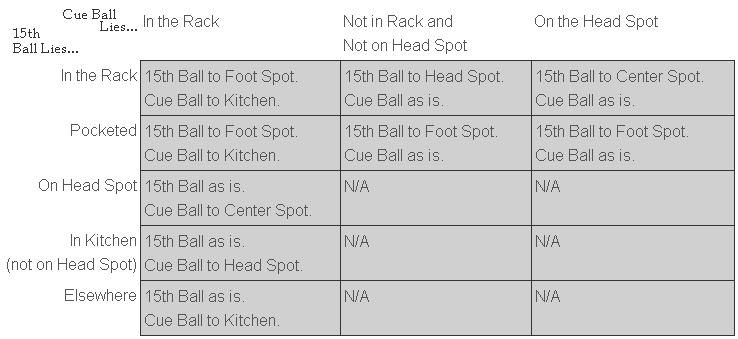
*on spot means to interfere with spotting a ball on the head spot.
A player may call a safety rather than an object ball for defensive purposes. Safety play is legal in 14.1 Continuous, but must comply with all applicable rules. The player's inning ends when a safety is played, and pocketed balls are not scored. Any object ball pocketed on a called safety is spotted.
- A player may not catch, touch or in any way interfere with a ball as it travels toward a pocket or the rack area on a shot. Doing so is a special deliberate foul and is penalized one point for the foul and an additional 15 point penalty, for a total of 16 points. The incoming player then has choice of either accepting the table in position with the cue ball in hand behind the head string, or having all 15 balls re-racked and requiring the offending player to shoot under the requirements of the opening break.
- If the 15th un-pocketed ball of a rack and/or the cue ball interferes with the triangle being lowered straight down into position for racking please refer to the chart above which indicates the proper manner of relocating balls. The gray boxes are those situations in which there is no interference, and both balls remain in position.
- When a player has the cue ball in hand behind the head string, as after a scratch, and all the object balls are behind the head string, the object ball nearest the head string may be spotted upon request. If two or more balls are an equal distance from the head string, the player may designate which of the equidistant balls is to be spotted.
Illegally Pocketed Balls (Regulation 6.8)
All illegally pocketed balls are spotted and and no penalties are assessed.
Object Balls Leaving the Table (Regulation 6.9)
When object balls leave the table, the stroke is a foul. Any jumped ball(s) is spotted once the balls come to rest.
Cue Ball After Jumping Off Of The Table and a Scratch (Regulation 6.10)
The incoming player has cue ball in hand behind the head string, unless the provisions 2, 5, and 12 of Rule of Play above apply to the offender's foul and dictate alternate choices or procedures.
Penalties for Fouls (Regulation 6.11)
One point is deducted for each foul incurred. Penalties are more severe for deliberate fouls (Rule of Play number 5 above) and the third Successive Fouls (See regulation 6.12 below). The incoming player accepts cue ball in position unless foul was a jumped cue ball, pocket scratch, deliberate foul or the third successive foul.
Successive Foul Penalties (Regulation 6.12)
When a player commits a foul, penalization is one point, or more as appropriate, and a notation is made and posted by the scorer that the player is on a foul. The player remains on a foul until the next shot attempt, at which time the foul may be removed by successfully pocketing a called ball, or completing a legal safety. If failing to meet these requirements on the next turn at the table, the player is penalized one point. The notation is changed to on two fouls. If the player fails to meet the requirements of successfully pocketing a called ball or completing a legal safety on the third consecutive turn at the table, penalization is one point and an additional penalty of 15 points is assessed. A total of 18 points for three consecutive fouls equals -18 points. The commission of a third successive foul automatically clears the offender's record of fouls. The incoming player has the choice of:
- Accepting the balls in position
- Having all 15 balls re-racked and requiring the offending player to shoot under the requirements of the opening break.
Rules for the opening break apply. It should be emphasized that successive fouls must be committed in successive turns or playing attempts, not merely in successive innings. For example, if a player ends inning six with a foul, steps to the table for inning seven and fouls (player is on two fouls), and then begins inning eight with a legally pocketed ball before scratching on his second shot attempt of the inning, he has not committed three successive fouls, even though there were fouls in three successive innings. As soon as the player legally pocketed the ball to start inning eight, the two fouls were cleared. The player is, of course, on one foul when they play the first stroke attempt of inning nine.
Note on Scoring (Regulation 6.13)
The deduction of penalty points can result in a player having negative scores. A running score can read minus one, minus two, minus 15, and so on. A player can win a game with a score of 150 while the opponent has scored only two fouls. The final score would read 150 to -2. If a player fouls on a shot that has not resulted in a pocketed ball, the point penalty is deducted from their score at the end of the previous inning. If a player fouls and pockets a ball on the same shot, that ball is spotted and the point penalty is deducted from their score at the end of the previous inning.
Stalemate (Regulation 6.14)
If the referee declares that neither player is attempting to win from the current position, he or she will announce their decision, and each player will have three more turns at the table. Then, if the referee still feels that there is no progress towards a conclusion, he or she will declare a stalemate and the original breaker at the beginning of the game must execute a new break shot.
14.1 Continuous Rules
If you have any questions about 14.1 Continuous Rules, please post them in the pool rules forum.
14.1 Continuous Rules History
According to some online sources, Straight Pool was created around 1910.
The official 14.1 Continuous Rules are predominently observed in North America.
The official governing body for 14.1 Continuous Rules is the Billiard Congress of America.
How to Play 14.1 Continuous
Questions about 14.1 Continuous Rules:
- 14.1 Continuous Scoring Specifics?
- 14.1 Continuous - Why 14.1?
- What Is 14.1 Continuous Billiards? Q&A
- Straight Pool is All About the Runs
- 14.1 Scoring
- 14.1 Continuous Pool
- 14.1 Continuous Foul penalty
- Anyone Play 14.1 Continuous?
- 14.1 Question About the 15th Ball
- How To Play Straight Rail Pool
- Re-Racking Rules for 14.1 Continuous
- 14.1 Break Ball Question
- 14.1 Continuous Rules Question
- Straight Pool Foul Rules and 14.1 Continuous Rules
- Who Breaks in Subsequent Games of 14.1 Pool?
- 14.1 Straight Pool, Eligible Ball?
- Use the Triange Rack to check if 15th Ball is in the Rack
- On a Foul in 14.1, Why Isn't a Pocketed Ball Placed on the Head Spot?
- Placement of the 1 and 5 Balls After Opening Break
- After 14th Ball is Pocketed and 15th Ball and Cue Ball are in the Rack
- Straight Pool Rule for when Cue Ball Ends Up in Rack?
- What are the Counters on a Pool Table Used For?
- 3 Foul Penalty in 14-1 Continuous Pool
- Title: 14.1 Continuous Rules
- Author: billiardsforum (Billiards Forum)
- Published: 1/1/2006 6:02:00 PM
- Last Updated: 10/24/2016 6:10:05 PM
- Last Updated By: billiardsforum
- Source: Internet
14.1 Continuous Rules
The 14.1 Continuous Rules article belongs to the Pocket Billiards Rules category. Pocket billiards is a class of cue sport game commonly referred to as pool.
14.1 Continuous Rules Comments
There are not yet any comments. Please post one below. All comments are moderated.
Reply and share your comments below:
