
18.2 Balkline Rules
Except when clearly contradicted by these additional rules, the General Rules of Carom Billiards apply.
Official 18.2 Balkline Carom Rules
18.2 Balkline, which is a variant of carom billiards, evolved from Straight Line or straight rail billiards in the late 19th century. Balkline plays much like Straightline carom billiards, though it partitions the billiard table into sections into baulks using balk lines, into which the ball must travel. The 18.2 balkline rules were meant to make billiards a more challenging game for the players, and more entertaining for spectators. Since the invention of balkline rules, balkline billiards has become the generic term for many different forms of carom billiards.
18.2 Balkline Rules - Players
The 18.2 Balkline Rules call for the game of 18.2 balkline to be played between either two individuals, or between two teams with an even number of players.
18.2 Balkline Rules - Equipment
Standard 18.2 Balkline Rules call for the use of a regulation/standard set of balls, and a standard carom billiard table. In addition to the normal markings found on the table the following areas shall be marked:
- Balk -- rectangular areas adjacent to the cushions with the outer edges 18-inches from the cushions. There are 8 balk areas.
- Anchor -- equally span two adjacent balk areas. They are 9-inches square and run out from the cushion. There are 8 anchor areas.
- Free -- is the center rectangle whose borders are those of the larger balk areas.
See the image of the 18.2 billiard table balk lines below:
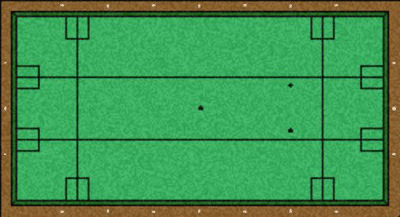
Here is an image of a guy playing 18.2 Balkline rules, on a table with white balk lines:
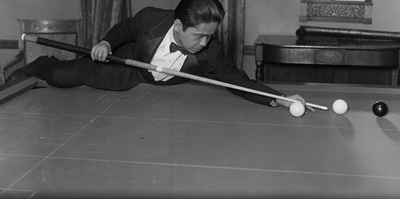
In the second image, "The Mighty Atom of the Billiard World", Kinrey Matsuyama of Japan is playing on a billiard table marked specifically for 18.2 balkline billiard play. He was nicknamed as such because of his extraordinary play in the World's Championship 18.2 Balkline Billiard Championship (shown in the image)...
18.2 Balkline Rules - Object of the Game
To reach a predetermined point count before your opponent.
18.2 Balkline Rules - Scoring
In 18.2 Balkline Rules, one point is scored each time a legal count is made, subject to the restrictions of the balk and anchor areas as described in the next section.
18.2 Balkline Rules - Opening Break Shot
According to 18.2 Balkline Rules, the red ball must be the first object ball contacted on the break shot.
18.2 Balkline Rules - General Rules
A legal counting stroke entitles the shooter to continue at the table until he or she fails to legally count.
The shooter, or an object ball, is said to be "in balk" or "in anchor" if both of the object balls lie within the same balk or anchor area on the billiard table. The player may score without regard to the balk areas at the beginning of the shooter's inning, or when one, or both, of the object balls come to rest in a new balk area.
If both of the object balls rest in the same balk area where the previous point was scored then the shooter is required to drive at least one of the object balls from that balk area in order to legally count.
One must note that if the shooter drives an object ball out of balk as required and it comes to rest in the same balk area it was just driven from (along with the other object ball) then the shooter is still in balk and must again drive at least one of the object balls from balk to legally count.
The anchor areas are played in the same manner as the balk areas. Note that one, or both, of the object balls may be driven out of balk but still be in anchor (the reverse can also hold).
A player may go for the count, or play safe as decribed in the General Rules of Carom Billiards. (See Above for link)
18.2 Balkline Rules - Fouls and Penalties
One point will be deducted from the offender's score for each foul. Any point made on a foul stroke will not count as it is not a legal count.
18.2 Balkline Rules
If you have any questions about 18.2 Balkline Rules, please post them in the pool rules forum.
18.2 Balkline Rules History
Brunswick Balke Collender Co. Used to publish it's own official rules, since it held tournaments.
The official 18.2 Balkline Rules are predominently observed in North America.
The official governing body for 18.2 Balkline Rules is the Nobody at the moment..
How to Play 18.2 Balkline
- Title: 18.2 Balkline Rules
- Author: billiardsforum (Billiards Forum)
- Published: 4/15/2009 9:54:00 AM
- Source: Internet
18.2 Balkline Rules
The 18.2 Balkline Rules article belongs to the Carom Billiard Rules category. Carom billiards is a class of cue sport games played on a pocketless carom billiard table.
18.2 Balkline Rules Comments
There are not yet any comments. Please post one below. All comments are moderated.
Reply and share your comments below:
