
9 Ball Rules
Learn how to play 9-ball with these simplified rules for 9-ball pool. Also see:
Before reading these, you should consult the General Rules of Pocket Billiards. Except when clearly contradicted by these additional rules, the General Rules of Pocket Billiards apply when playing 9 Ball.
9 Ball Rules - How To Play 9 Ball
This page contains references to some material that is copyrighted by the Billiard Congress of America. Any modification or sale of such information herein is strictly prohibited by the laws governing that copyright. Please direct questions regarding interpretation of the following, or information on how to receive the current BCA "Billiards - The Official Rules and Records book" to the Billiard Congress of America.
If there are any terms throughout the 9 Ball rules that you do not understand, you can search our billiard terms glossary in the search box near the top left of the page, or search the billiard terms glossary directly. I have also included the Billiard Congress of America's reference numbers, so that readers can reference each rule back to the specific rule text on the Billiard Congress of America website.
9 Ball - Object of the Game and General Description (Regulation 5.1)
9 ball is played with a cue ball and nine object balls numbered 1 through 9.
9 ball is a "rotation" game, meaning that the balls are shot in numerical order. The shooting player must strike the lowest numbered ball on the table first. Players are not required to call any shot, and the game is won when the nine ball is pocketed. A player retains their turn at the table as long as they strike the lowest numbered ball first, avoid fouls, and pockets a ball on each shot. After a miss, the incoming player must shoot from the position left by the previous player, but after any foul the incoming player may start with the cue ball anywhere on the table. The player need not pocket the lowest numbered ball to continue shooting. He may, for example, shoot the 1-ball into the 4-ball thus pocketing the 4. He will continue shooting but must again strike the 1 ball first. If the player shoots the 1-ball into the 9-ball and the 9 is pocketed, the game is over.
Racking the Balls (Regulation 5.2)
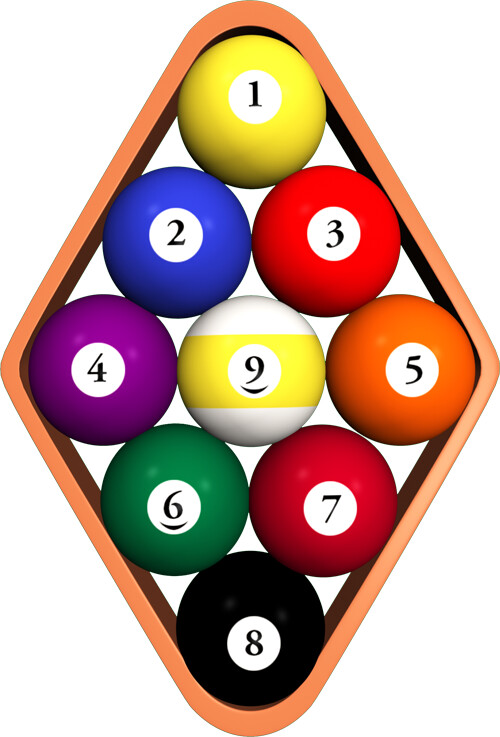
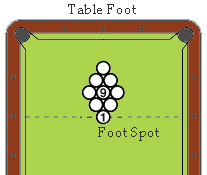
The same as in 8-ball, but only 9 balls are used and are racked in a diamond shape. The balls are racked with the 1-ball at the top of the diamond and on the foot spot, the 9-ball in the center of the diamond, and the other balls in random order. The balls should be racked as tightly as possible. 9 Ball games begin with cue ball in hand behind the head string.
Below is a picture showing the proper way to set up the rack in 9 Ball Rules:
Order of Break (Regulation 5.3)
The winner of the lag has the option to break the rack. In 9-Ball, the winner of each game breaks in the next, unless otherwise specified by the 9 Ball tournament organizer. The following are common options that may be designated by various tournament officials in advance:
- Players alternate break.
- Loser breaks.
- Player trailing in game count breaks the next game.
Legal Break Shot (Regulation 5.4)
The rules governing the break shot are the same as for other legal shots except:
- The breaker must strike the 1-ball first and either pocket a ball or drive at least four numbered balls to the rail.
- If the cue ball is pocketed or driven off the table, or the requirements of the opening break are not met, it is a foul, and the incoming player has cue ball in hand anywhere on the table.
- If on the break shot, the breaking player causes any object ball to leave the table, it is considered a foul. At this juncture, the incoming player has cue ball in hand anywhere on the table. The object ball is not re-spotted (exception: if the object ball is the 9-ball, it is re-spotted).
After The Break
Various circumstances can occur upon completion of the break. They are:
- A foul on break shot will result in a cue ball in hand anywhere on the table for the breaker's opponent. Pocketed balls, if any, stay in the pocket and are not spotted, except for the 9-ball.
- No balls are pocketed and it is the other player's turn.
- The 9-ball is made. This is a winning scenario unless the shooting player scratches. In this case, the 9-ball or any other high numbered ball is spotted and the turn is passed to his opponent.
- One ball or a number of balls are pocketed. It is still the breaker's turn and they shoot the lowest numbered ball on the table.
- Occasionally it occurs that the player mistakenly hits the wrong ball. Although it is sportsmanlike for the sitting player to remind the shooting player he is about to foul by shooting at the incorrect ball, they are not required to do so. Once the player has hit the wrong ball, the foul has occurred whether the ball was pocketed or not. If the ball is pocketed, it is permissible, though not recommended, that the sitting player allow the shooting player to continue shooting until he feels inclined to call the foul. The shooting player can escape penalty by quietly realizing his error and returning to shoot the correct ball and striking it first on a shot prior to his opponent calling the foul. In other words, the sitting player must call the foul before the shooting player has struck the correct ball.
Continuing Play After The Break (Regulation 5.5)
On the shot immediately following a legal break, the shooter may play what is known as a "push out." (See below) If the breaking player pockets one or more balls on a legal break shot, he or she continues to shoot until they miss a shot, foul, or win the game. If the player misses or fouls, the other player begins an inning and shoots until missing, committing a foul, or winning. The game ends when the 9-ball is pocketed on a legal shot, or the game is forfeited for a serious infraction of the rules.
Push Out (Regulation 5.6)
The billiard player who shoots immediately after a legal break may play a push out in an attempt to move the cue ball into a more favorable position for the option that follows. On a push out, the cue ball is not required to contact any object ball nor any rail, but all other foul regulations still apply. The player must announce his or her intention of playing a push out before the shot, or the shot is considered to be a normal shot. Any pocketed ball on a push out does not count and remains pocketed except for the 9-ball. Following a legal push out, the incoming player is allowed to shoot from that particular position or to pass the shot back to the player who pushed out. A push out is not considered to be a foul as long as no rule, except for the "Bad Hit" regulation and the "No rail" regulation, is violated. An illegal push out is penalized according to the type of foul committed. After a player scratches on the break shot, the incoming player may not play a push out.
Fouls (Regulation 5.7)
When a player commits a foul, he or she must relinquish their inning at the table. Additionally, none of the balls pocketed on the foul shot are to be re-spotted. An exception to this regulation is if a pocketed ball is the 9-ball, it shall be re-spotted. The incoming player is granted ball in hand meaning that prior to their first shot they may place the cue ball anywhere on the table. If a player commits several fouls on one shot, they are counted as only one foul.
Bad Hit (Regulation 5.8)
If the first object ball that is contacted by the cue ball is not the lowest numbered ball on the table, the shot is considered a foul.
No Rail (Regulation 5.9)
If no object ball is pocketed, a failure to drive the cue ball or any numbered ball to a rail after the cue ball contacts the object ball on is considered a foul.
Cue Ball In Hand (Regulation 5.10)
When the cue ball is in hand, the player may position the cue ball anywhere on the playable bed surface of the table. He or she may not place it in such a position that it is in contact with an object ball. The player may continue make adjustments to the position of the cue ball until shooting.
Jumping Object Balls Off The Table (Regulation 5.11)
An un-pocketed ball is considered to be driven off the table if it comes to rest in a place other than on the bed of the table. It is considered a foul to drive an object ball off the table. The jumped object ball is not re-spotted when this occurs. An exception is made if the object ball is the 9-ball, in which it is re-spotted, and play is continued.
Jump and Massé Shot Fouls (Regulation 5.12)
If a match is not presided over by a referee, it will be considered a cue ball foul if during an attempt to jump, curve, or masse the cue ball over or around an impeding numbered ball, the impeding ball moves, regardless of whether it was moved by cue stick follow-through, a hand, or bridge.
Three consecutive Fouls (Regulation 5.13)
If a player fouls three consecutive times on three successive shots while failing to make an intervening legal shot, the game is lost. The three fouls must occur in one game, and the warning must be given between the second and third fouls. A player's inning begins when it is legal to take a shot and ends at the end of a shot on which he or she misses, fouls, or wins, or when he or she fouls between shots.
Stalemate (Regulation 5.14)
If the referee finds that neither player is attempting to win from the current position, the referee will announce his or her decision, and each player will have three more innings at the table. Then, if the referee still feels that there is no progress towards a conclusion, he or she will declare the rack a stalemate and the original breaker of the rack will break once again.
Ending of the Game (Regulation 5.15)
On the opening break, the game is considered to have commenced once the cue ball has been struck by the cue tip. The 1-ball must be legally contacted on the break shot. The game ends at the end of a legal shot which pockets the 9-ball, or when a player forfeits the game as the result of a foul, or multiple fouls.
9 Ball Rules - Other 9 ball Information
Saving Money
When using coin operated tables to play 9 Ball, you can save some money by using all the balls in the event of a short game. for example, if the 3 and 9 are made on the break, the balls are re-racked (because a 9 on the break is a winner) using the 10 and 11 balls. The sequence in the next game is 1, 2, 4, 5, 6, 7, 8, 10, 11. The 11, in effect, is the "9-ball", the last ball, in this game. Avoid making replacements such as the 10 replaces the 3; it is too confusing. Shoot the balls in numerical order.
Other 9 Ball Notes
- Combination shots are legal and extremely common in the game of 9-ball. Keep in mind that one must make sure to hit the lowest numbered ball on the table first.
- Balls must remain in a pocket to be legal. If a ball goes into a pocket but bounces back onto the playing surface, it is not considered pocketed.
- It occasionally happens on tables with small pockets that two balls become jammed in a pocket and are leaning over the edge of the slate to some degree. They are off the playing surface and are pocketed. Throw them in and resume playing the game unless the pocketing ends the game.
Scoring
A player receives a point for every ball pocketed, except those pocketed when he or she scratches or otherwise fouls. The player receives two points for pocketing the 9-ball.
9 Ball Rules
If you have any questions about 9 Ball Rules, please post them in the pool rules forum.
9 Ball Rules History
Nine-ball (9 ball) is a contemporary form of pool, with historical beginnings rooted in the United States and traceable to the 1920s. Also see the article on the history of nine ball pool.
The official 9 Ball Rules are predominently observed in North America.
The official governing body for 9 Ball Rules is the World Pool-Billiard Association.
How to Play 9 Ball
Questions about 9 Ball Rules:
- Ball In Hand In Nine Ball
- Intentionally Pocketing The 9 Ball
- When A Ball Falls Into the Pocket On It's Own
- Foul to Jump Object Ball Off of the Table in 9 Ball?
- Fouls and Cheating in 9-Ball
- 9 Ball Rules for Pocketing Balls Other Than the Called Ball
- Playing "the ghost" in 9-ball
- 9 Ball on Foot Spot for Break?
- Nine Ball Pocketed Unintentionally
- Combination and Carom Shots in 9 Ball
- Intentionally Pocket 9 Ball to Have it Spotted
- New to 9 Ball, I have a few questions
- 9-Ball Push Rule
- Why Bother With Points System in 9 Ball?
- Pocketing the 9 Ball In the Wrong Pocket
- Cue Ball Allowed to Come to Rest After a Foul
- 9 Ball Rules for Fouls and Spotting Balls
- How to Set Up a Rack in 9 Ball
- Hitting an Object Ball Other Than the One You Intended in 9-Ball
- Pocketing the 9 Ball and Cue Ball off the Break in 9-Ball
- Pocket 9 Ball then the Cue Ball Goes In
- 3 Consecutive Illegal Breaks in Nine Ball
- Pocket the 9 Ball in the Wrong Pocket
- Apa 9 Ball Break Rules
- Calling Safety, Pocket an Object Ball, and Relinquish Turn
- Playing "Call the 9 Ball Only" and Missed Combo Shots
- Legal 9 Ball Break. BCA Rules
- APA 9-Ball Scoring when Sinking the 9-Ball on the Break
- Penalty for Pocketing the 9-Ball Early
- Ball in Hand After Missing the Rack on the Break Shot in 9-Ball
- Does the Inning End if Player Calls "Safety" and Pockets a Ball?
- What Happens in 9-ball If a Patron Yells the Next Ball Number
- Does the "3 Consecutive Foul Rule" Apply if Other Player Fouls After My 2nd Foul?
- 9-ball Foul
- Hitting Another Ball After Pocketing the 9 Ball
- Title: 9 Ball Rules
- Author: billiardsforum (Billiards Forum)
- Published: 1/1/2006 9:22:00 PM
- Last Updated: 1/27/2019 10:12:39 AM
- Last Updated By: billiardsforum
- Source: Internet
9 Ball Rules
The 9 Ball Rules article belongs to the Pocket Billiards Rules category. Pocket billiards is a class of cue sport game commonly referred to as pool.
9 Ball Rules Comments
- ALLAN from Philippines on 4/28/2008 11:35:39 AM
What happens if you shot the first ball and it was a scratch? Does the first ball stay pocketed or does it get re spotted back in to position.
- james from Atlanta, GA on 4/30/2008 10:04:04 AM
In Nine Ball, if I hit the one ball first and then my cue ball hits the 4 ball and makes it without making the one ball is that a legal shot and its still my turn?
- Duane from Pittsburgh, PA on 6/8/2008 5:52:45 PM
While playing nine ball, a player is awarded ball in hand. During placement of cue ball in a tight area no balls are touched. player continues to adjust cue ball back out of tight area and settles on final placement of cue ball. Can a measurement foul be called on player during this adjustment of cue ball in and out of tight area?
- carl from Idaho on 11/4/2008 4:19:29 PM
In 9-ball if you miss the object ball, but the q-ball strikes a rail and no other ball, is that a legal miss and loss of turn ?
- Bear from Savannah, GA on 11/16/2008 7:37:38 PM
In nine ball with the nine Ball being the only ball on the table and the cue ball strikes the nine ball dropping the nine ball in a pocket and the cue ball drops in the pocket as well how is the game played out or does the individual that sank the nine ball and scratched at the same time win?
- joe on 12/14/2008 9:47:42 PM
I was informed that setting the pool cue on the table is a foul...I was also told, that that is only true for aimming a ball...ex...a player is playing 9 ball he runs into a shot which he tries to shoot right handed and sets cue on table and walks around the other side and pickes up cue and shoots it left handed...is this a foul?
- hank on 2/5/2009 5:23:50 PM
Are push shots legal in 9 ball billiards?
- Willem from Amsrerdam on 2/19/2009 9:37:49 AM
I want to know what do you meen by the term scratches?
- Bear from Savannah, GA on 2/24/2009 5:15:51 PM
Term scratch is meant to be interpreted as a foul
- mike from chicago on 3/4/2009 9:58:49 AM
Does the nine ball have to be called? and if you contact your object ball, and slop in the nine, is that leagal?
- eddie from malaysia on 7/29/2009 11:57:34 PM
if pocket the 9-ball by using another ball is a win, then what happens when you scratch doing that?
Hinds-57 from Seattle, WA on 8/14/2009 3:24:33 AM
I hope you can help me out on this issue. I was playing 9 ball with friends the other day. They are all pool novices and have never played 9 ball before...I have played the game before and have an appreciation for billiards in general. My firend Jeff sank the nine ball on the first break he ever ook playing the game. My othe friend Michael was ready to break next and I explained that Jeff should keep going, and break again. To my amazement he made the 9 ball again. We were all excited but I knew this was rare. I told Jeff he had to break again. Yes! The 9 ball went in again. Unbelievable! On his 4th attempt he failed....however, this has made me think. How often has this happened before? Or has it even happended before? And what are the odds? Very high I would think. I am asking you if you know how we could figure this out. any help would be appreciated. Thanks, John in Seattle
- Nante from Philippines on 9/7/2009 6:39:05 AM
What happens if the 1 ball is hit first and then 9 ball is pocketed together with the cue ball?
- Nate from Philippines on 9/7/2009 6:45:35 AM
What happens to player #1 if he hits the target ball, or the lowest ball in the table, and then pocketed the 9 ball together with the cue ball?
- Mark Smith from Sundre, AB on 11/25/2009 3:46:01 PM
1. WHEN SHOOTING THE OBJECT BALL ONTO THE NINE TO WIN DO YOU CALL THE SHOT & CALL THE POCKET & WHAT IF I CALLED THE SHOT & POCKET BUT MISSED & THE NINE WENT INTO ANOTHER POCKET? 2. WHEN THE NINE IS THE LAST BALL, I SHOOT BUT FOUL OR SCRATCH THE WHITE, DO I LOOSE OR IS IT BALL IN HAND. 3. WHEN THE NINE IS THE LAST BALL, I SHOOT FOR THE CORNER BUT MISS & IT GOES AROUND THE TABLE & DROPS IN THE SIDE OR ANY OTHER POCKET THAN THE ONE I WAS SHOOTING AT, DO WE SPOT THE NINE & CONTINUE OR DO I LOOSE?
- johnskrb from Buffalo Grove, IL on 12/13/2009 7:42:58 AM
How is pocketing the 9 via slop handled?
Reply and share your comments below:
