
Straight Rail Billiard Rules
Welcome to the rules of Straight Rail carom billiards.
Rail or Straight Rail Billiard Rules (Carambole Billiards)
It is said to be a good game to play when one wishes to learn precise shot control. One billiard forum member suggests that by playing Straight Rail Billiards, one can learn to perfect their soft shots and safety play for other billiard games. I have tried to communicate the generalities of Straight Rail as best as possible, however, because of the limited information available on the game, and the lack of exposure that our editors have to the game, the information may be incomplete. Please contact us if you have any more information about this game. We'd love to learn more!
Game Play
Rail is played with two players. Each player has a white ball that will be their cue ball when they are shooting. One player will have the solid white ball, while the other has the spotted white ball. One player will thus be "white" and the other player, "spot." Rail is played with a third ball which is normally the red ball.
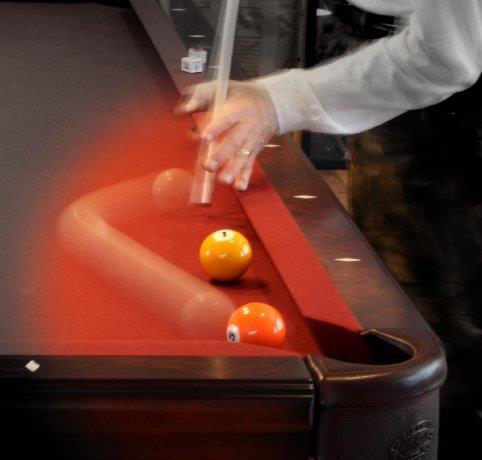
Each time your cue ball makes contact with the red ball and with the other white ball on the same shot, you score a "count." The first player to reach a predetermined number of counts is the winner. The goal is to "gather" the balls and bring them close together, and preferably drive them in to a corner.
There is apparently a way for a player to cheat in the game of "Rail," as was found online. As noted before, because of the limited information available on this game, this information should be taken as informal. There may be additional, official rules that prevent such an action. The cheat can be preformed by "Crotching the balls," that is, by getting the two object balls frozen together in one of the corners of the table. The shooting player can then shoot their cue ball off the two object balls repeatedly, without moving them. This will allow the shooter to accumulate the predetermined number of counts very quickly. This apparently occurred in 1879 when Jacob Schaefer Senior scored 690 points in a single inning by employing this strategy. One would say that may have been boring to watch, but 690 separate strokes without a miss is a feat in itself. This particular technique is often called the "rail nurse" as the player is "nursing" the rail with such shots.
Position play is extremely important. This is a game that is usually won by "not missing" rather than by making "great shots." This can be accomplished by setting up, and playing only easy shots. An "easy shot" would be one where all three balls are very close together. In situations where this is not directly possible, you can shoot the cue ball away from the other two, with the aim to bring it back.
Equipment
Straight Rail Billiards is generally played on 5 foot by 10 foot table. (A full-sized pool table is 4.5 feet by 9 feet.) Straight Rail Billiard tables are often heated to about eight to ten degrees above normal room temperature. This procedure helps to keep moisture out of the cloth to aid the balls in spinning, and in rolling and rebounding in a consistent manner. The cloth on this type of table is finer than that of a traditional pool table, and allows for the balls to roll much further.
It has been said that at one time, one of the cue balls contained a small black dot on it to aid the players with differentiation. This ball was fittingly called the "black ball." In today's games, one cue ball is yellow, and the other white. The balls are generally larger than those used in playing traditional pocket billiards.
The cue sticks used in Straight Rail Billiards tend to be shorter, stiffer, and smaller in circumference than pocket billiard cues. For example, billiard expert Brian Mordt suggests using a "billiard" cue and not a "pool" cue for Straight Rail Billiards. There are major differences in how these cues perform. They are each designed in such a way that is specific to the game being played. He recommends that for 3 cushion and straight rail billiards one uses Helmstetter carom cues. The are priced reasonably and play well.
Unfortunately, information on this game is rather limited. In fact, there is very little material available on Straight Rail in English. If you know of any specifics relating to Straight Rail Billiards other than what is listed here, Please contact us. We'd love to learn more!
Straight Rail Billiard Rules
If you have any questions about Straight Rail Billiard Rules, please post them in the pool rules forum.
Straight Rail Billiard Rules History
Rail, also known as Straight Rail Billiards, is a very old game (Circa 1800's) that is said to be a derivative (American version) of Carambole Billiards, and the forerunner of all American Carom Billiard games. In fact, the rules of play that Straight Rail Billiards is based on are known to date back to the 1700s. Though the history of the name of the game is not known, there was a New York Times article in the March 23, 1881 edition where an early mention of Straight Rail occurs. This issue referred to it as "the straight rail game." The first straight rail match held publicly in the USA occurred in San Francisco in 1855. The Crotching technique was banned in 1862.
The official Straight Rail Billiard Rules are predominently observed in Europe and North America, although Straight Rail is less popular in North America..
The official governing body for Straight Rail Billiard Rules is the Union Mondiale de Billard.
How to Play Straight Rail Billiard
Questions about Straight Rail Billiard Rules:
- Title: Straight Rail Billiard Rules
- Author: billiardsforum (Billiards Forum)
- Published: 6/28/2006 11:48:00 PM
- Last Updated: 3/22/2008 9:50:33 AM
- Last Updated By: billiardsforum
- Source: Internet
Straight Rail Billiard Rules
The Straight Rail Billiard Rules article belongs to the Carom Billiard Rules category. Carom billiards is a class of cue sport games played on a pocketless carom billiard table.
Straight Rail Billiard Rules Comments
Charlie Roche from Florence, Italy on 2/8/2008 10:36:34 AM
I was reading your article on straight-rail billiards.
To be honest I'm not sure if it's the same as what I play here in Italy, but we call it Three Rail Billiards.
The differences are as follows.
- Instead of the spotted white, we have a yellow ball.
- You must go off three rails in one of the following ways.
- strike opponents ball, then three rails, then red
- strike red ball, then three rails, then opponents ball
- three rails, then the two balls, in any order you like
Again, I'm not really sure if I'm off base here. Over here this game is really popular. I play 9-ball but I'm the exception to the rule.
Mark Altherr from New York, NY on 8/5/2008 4:33:39 PM
@Charlie Roche is describing three cushion billiards.
In straight rail billiards the starting position is with the red ball on the foot-spot and the yellow and white cues on the two head spots which are about 8 inches apart.
In straight rail billiards:
Rod G from Austin, TX on 8/6/2008 10:12:05 AM
@Mark, Thanks for the info.
I play 3 cushion in Round Rock, Texas (near Austin) about 20 hours per week. A friend of mine convinced G-Cue billiards to let him put in a heated Verhoeven table.
My interest in straight billiards comes from a comment that Raymond Ceulemans made about American players. i.e. the gist of the comment was:
Americans will never be able to play 3 cushions because they don't play the small games and learn to control all 3 balls...
I'm having trouble getting anyone to play straight billiards around here and certainly my lack of knowledge of the rules for straight rail billiards won't help. I've you are ever down this way give me a call.
Thanks again,
Rod Gustafson
(512) 835-2042.@Rod G - Thanks for the invite.
Ray Ceulemans just gave a 3 cushion demonstration match at my club against another Belgian world champion (whose name eludes me, though he is quite well known).
We have played straight rail for years and only added a 3-cushion tournament this year.
Given the difficulty of three cushion I'm surprised you don't get more straight rail players as an intro to 3 cushion.
It is also a great skill for Cowboy Pool which is very big among the clubs (private social clubs) in New York.
JES45 from Laguna Hills, CA on 2/8/2009 12:10:21 PM
I've been playing billiards and pool since 1970 (so for almost 50 years) and I have never heard the term "straight rail billiards" before.
The game you sort of describe here is called "red ball" except you have to hit the red ball first in that game.
You don't even talk about "3 rail billiards", which is THE game to play.
@JES45 - Jim, three-cushion and straight-rail are two different games with most of the same rules, like hitting red first.
bn1 from Palisades Park, NJ on 8/26/2009 10:47:05 AM
I am from northern New Jersey and there are several places with straight rail and 3 cushion billiards tables in the area. There are also some pool halls with a straight-rail billiards tables in New York City, NY and Flushing Queens, NY. Most of these pool rooms are Korean owned and operated.
The most common games found are 3-cushion and 4 ball billiards (an Asian variation of straight rail). In 4 ball, there is an extra red ball. The balls are slightly larger and heavier. The main differences between regular straight-rail and 4-ball are:
The two red balls are the object balls. If you hit the opponent's cue ball, it is a 1 point penalty. Also, you get a 1 point penalty (and lose turn) if fail to hit any object balls or the ball flies off the table, or if you accidentally touch the ball with you body, etc.
When you reach the predetermined number of points, you must finish with a 3 cushion shot. However, when you get to the 3 cushion shot - there are no 1 point penalties if you miss or hit the opponent's cue ball.
The most famous place is probably Carom Cafe in Flushing, Queens, NY. They hold the annual Lee Sang Chun memorial tournament which draws world class players such as Semih Sayginer, Ray Ceulemans, Blohmdahl, Caulderon etc.
Other places you can find to play straight rail billiards in NJ are:
- Royal Billiards and Star Billiards in Little Ferry, NJ
- Sports Billiards and Joker Billiards in Palisades Park, NJ
Here is a video carom cafe:
Jmar from Los Angeles, CA on 12/16/2009 11:00:34 AM
I actually play a lot of straight rail pool as it helps with safeties, but NO ONE else will play.
In balkline you can only score 1 or 2 points (depending on whether you're playing 18.1 or 18.2) in any of the 18 rectangles before you must make a ball leave the rectangle. I can barely nurse the balls well enough to keep them in a rectangle so I don't worry about it.
There's a place here in Los Angeles to play Korean billiards. It's a phenomenal game. They play straight-rail like games there that, in Korean, are called samgu and sagu:
- Sam-Gu is the same as 4-Ball ("sam" = four, "gu" = ball)
- Sa-Gu is the same as 3-Ball ("sa" = three, "gu" = ball)
They do play Sa-Gu with big carom size balls but when they play Sam-Gu, which is exactly like three cushion, they use pool sized balls and they play on 9-foot billiards tables.
As far as playing "standard three cushion", I go a to a couple places. One is Hard Times pool hall in Bellflower, CA, which is an amazing pool hall. They have some heated Gabriels billiards tables that play amazing. But, my favorite place to play, by far, is with the Mexican folks over in Highland Park, CA. They call it Carombola and they are the biggest carom community I can find in California. Believe it or not "taco" is Spanish for "pool cue".
Sorry if my thought seem scattered it's because I've been up all night playing video games.
@Mark Altherr - I was only questioning the name "straight rail". I believe it's the same game called "red ball". However, I think you are incorrect regarding having to hit the red ball first in 3 rail billiards.
This debate is becoming silly.
Type "Straight Rail Billiards" into your browser and you will immediately get a bunch of straight rail or straight billiard options to look at. They have nothing to do with Korean billiards, or" 4 ball", or "red ball".
Even a site as vanilla as Wikipedia discusses this stuff. Here is but one example, outlining a history of straight rail billiards:
A History of Straight Rail Billiards
Balkline (balk line or balk-line) is the overarching title of a large array of carom billiards games generally played with two cue balls and a third, red object ball, on a cloth-covered, 5 foot to 10 foot, pocket-less table that is divided by balklines on the cloth into marked regions called balk spaces.
The balkline games developed to make the precursor game, straight rail, more difficult to play and less tedious for spectators to view in light of extraordinary skill developments which allowed top players to score a seemingly endless series of points with the balls barely moving in a confined area of the table playing area. Straight rail, unlike the balkline games, had no balk space restrictions, although one was later added. The object of the game is simple: one point, called a "count", is scored each time a player's cue ball makes contact with both object balls (the second cue ball and the third ball) on a single stroke. A win is achieved by reaching an agreed upon number of counts.
Carom billiards players of the modern era may find it astounding that balkline ever became necessary given the considerable difficulty of straight rail. Nevertheless, according to Mike Shamos, curator of the U.S. Billiard Archive, "the skill of dedicated players [of straight rail] was so great that they could essentially score at will." The story of straight rail and of the balkline games are thoroughly intertwined and encompass a long and rich history, characterized by an astounding series of back and forth developments, akin to a billiards evolutionary arms race, where new rules would be implemented to make the game more difficult and to decrease high runs to keep spectators interested, countered by new shot inventions and skills interdicting each new rule.
The Rise and Fall of Straight Rail
Straight rail from which the balkline games derive, sometimes called carom billiards, straight billiards, the three-ball game, the carambole game, and the free game in Europe, is thought to date to the 1700s, although no exact time of origin is known. It was known as French caroms, French billiards, or the French Game in early times, taking those bygone names from the French who popularized it. The derivation of the name straight rail is not clear. An early mention appears in the March 23, 1881 edition of the New York Times wherein it is referred to as "the straight rail game".
At straight rail's inception there was no restriction on the manner of scoring, such as a number of cushions that must be contacted on a shot, as in the game of three cushion billiards, nor a requirement that the balls leave a region of the table, as in the balkline games.
In 1855, the first public stakes straight rail match in the U.S. took place in San Francisco. The contestants, Michael Phelan and a Monsieur Damon of Paris battled for seven hours, but the high run, set by Phelan, was just nine points. A technique that soon developed, known as crotching, vastly increasing counts. The crotch refers to the space at the corner of a table where the rails meet. By freezing the two object balls into the crotch, a player could endlessly score off them, all the while keeping them immobilized in that corner.
Straight rail became progressively more popular and skill in the game increased commensurately. For example, Albert Garnier, author of Scientific Billiards (1880) and the champion of the first world title straight rail tournament in 1873, averaged 12 points over the course of the competition and posted a high run of 113. Although unimpressive compared with later records (in 1931 legendary player Charlie Peterson achieved an astounding 10,232 high run count), the many-fold increase in scoring average and high run as compared with the 1855 contest was a result of refinement of gather shots and, most importantly, the development of a variety of "nurse" techniques (also called nursery cannons in the UK).
Doub from South Bend, IN on 12/28/2009 12:39:23 PM
It has been said that at one time one of the cue balls had a black dot on it
My goodness, you think that game started in the eighth century. You can still buy those funny balls at the pool hall.
And for all of the disagreements; All you guys have to do is buy the book by Marice Daly on Carom Billiards and... Voilla! (links to amazon.com)
SlickRick_PCS from Dallas, TX on 1/4/2010 12:11:36 PM
@Jmar: Yea, Mexicans would call a pool cue taco de billar in Spanish.
@Rod Gustafson: Although I live in the Rio Grande Valley, I definitely play the small carom games:
- Straight Rail (or "free-game", as the Euros call it)
- 47.1 and 47.2 (basically 18.2 and 18.1 in "metric")
- 71.2
- 28.1 (which is in inches and only has four balk spaces... unlike 71 cm where it has six)
- Cushion Caroms (a.k.a: one-cushion)
Three-Cushion is really fun, but I would rather wait until I get better at the smaller games.
I'll give you a call sometime in the later future.
Christoph Hilger from Krefeld, Germany on 1/8/2010 2:37:52 PM
I'm Christoph Hilger, a professional billiard player from Germany.
I tried to translate this in English but I had some problems understanding. I also read the text at en.wikipedia.org/wiki/Carom_billiards to get some terms but I'm not sure that it is alright.
I will keep checking back to learn more about English translation of how to play straight rail billiards.
Chuck from Cortez, CO on 12/4/2015 9:40:23 PM
Crotching is getting two balls stuck in the corner so they can be both struck without either moving. This "technique" has been banned ever since it was figured out and used to win once. Anyone still playing straight rail will not allow this ever.
The rail nurse is not the same. It is a shot that moves both object balls along the rail, and leaves you in position to repeat the shot, with them further along the table. This requires much more skill to abuse than crotching, but abuse it people did.
There's also:
- the chuck nurse
- the pass nurse
Use of the latter is not cheating. Use of the former is a reason people don't play straight rail anymore. It even worked in balkline before anchor spaces were added.
Tee from Mannington, WV on 12/31/2017 8:44:50 PM
I have been playing pocket billiards and carom billiards for over 50 years (I like carom billiards better). I have played all sorts of carom games including straight-rail, 3-cushion, red ball, one-cushion and other games involving 4 balls, choice of cue ball, etc.
I have always preached that carom play will hone your skills in controlling the cue ball and therefore improve your position play in pocket pool.
I am 69 years old and have been playing carom billiards for 51 years, mostly straight-rail but also other games such as 3-cushion, 1-cushion, red ball, and balkline.
You mention in your write-up a method to cheat, or "crotching the balls" in a corner and making a high run. This is not really considered cheating in straight-rail. In fact, in the late 1800s when skilled players were able to crotch the balls in the corners new games were devised - Balkline 14.1, 14.2, 18.1 and 18.2 - to prevent high runs and make play less boring. I do not believe anyone plays these games today.
The game of preference is now 3-cushion. My two sons and I purchased a pool table in 2008 then converted it to a carom table in 2009. We perhaps have the only private carom table in our home state of West Virginia.
But I thought your write-up was very good and informative.
SWFLguy from FL, United States on 1/4/2020 2:53:40 PM
I played a lot of billiards in college, mostly pocket billiard games.
I did play some straight rail, a few 3-cushion games. I saw some upper level players play 5 cushion, but that game was not within my ability.
Reply and share your comments below:
